TEG Index at a glance
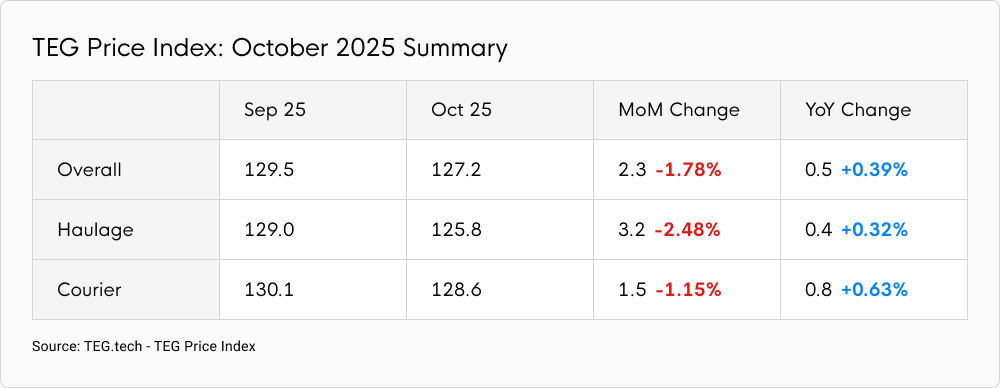
Aligning with historical trends, October saw the TEG Price Index drop 2.3 points (1.78%) to 127.2. Year-on-year, the index was up just 0.5 points (0.39%).
The Haulage Index saw slightly more movement than the overall index, falling 3.2 points (2.48%) last month. Compared to October 2024, it was 0.4 points (0.32%) higher. Meanwhile, artic vehicles reflected the Haulage Index movement, falling 2.8 points (2.3%).
The Courier Index fell 1.5 points (1.15%) in October. This put it a modest 0.8 points (0.63%) higher than a year ago.
High availability for a second consecutive month
Vehicle availability continued to outstrip demand in October. Following September’s jump, overall vehicle availability rose by 18.9% in October, and artic availability increased by 21.7%.
In contrast, demand dropped by 5.4% overall (and by 17.1% for artics).
The shifts in both availability and demand reflect those of October 2024, while October 2023 saw flatter movement.
Are consumers holding back?
The average HGV driver salary rose by 1.2% in October to £42,968. We’ve seen a rise each month since February 2025 alongside a continued increase in vacancies, with October reporting the highest yet – 5,639. That said, the increasing availability we’re seeing suggests many agency drivers are now returning to the market having enjoyed time off during the warm summer.
And yet, demand has dropped. While it may seem obvious to blame the state of the economy, the GfK Consumer Confidence Index rose two points in October, suggesting a more positive sentiment from shoppers. Perhaps, rather the sluggish economy, consumer demand has shifted during 2025. This year's particularly sunny summer months encouraged early spending. Meanwhile, Black Friday has become a well-established event in the seasonal calendar, and those looking to make significant purchases may be holding off in the hope of great deals.
Restraint in October may become the norm for years to come.
Industry pulse
All eyes are on predictions for the government’s 26 November autumn budget when Chancellor Rachel Reeves will explain how she intends to fund an estimated £22 billion shortfall in the government’s finances. The Institute for Fiscal Studies think tank says she will "almost certainly" have to raise taxes.
The transport industry rightly fears a reversal of the 5p fuel duty cut, with some predicting the introduction of a pay-per-mile scheme. But consulting firm RSM UK points to HMRC data that shows a downward trajectory for fuel duty receipts, reflecting the ongoing transition to electric vehicles. In September, electric van uptake surged to 41.1%; the best month ever, even though the overall LCV market dropped by 2.1%.
With such changes in vehicle stock, the Office for Budget Responsibility (OBR) has predicted that fuel duty revenue may only represent 2% of total tax revenues for 2025/26 (down from 7% in 2019/20). That doesn’t feel like a significant tax revenue source to alter.
The Bank of England expects a tough discussion on 6 November when deciding whether to drop interest rates or hold them at 4%. Given lacklustre economic growth and likely tax rises in the budget, several major banks predict a cut to 3.75%. But others point to inflation remaining stubbornly high and suggest a drop would do nothing to ease it.
With around 20% of UK mortgage holders holding variable-rate mortgages, any interest rate cut would significantly boost consumer spending power. But tax rises could quickly lessen the impact. As we approach peak season, November’s economic decisions are sure to influence demand and, in turn, transport pricing trends.
Fuel Watch
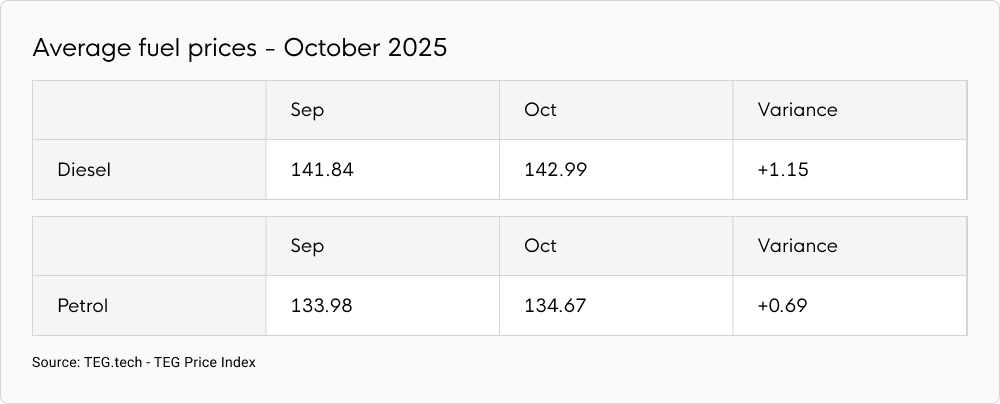
Fuel prices nudged upwards for another month in October. Average diesel prices rose to 142.99p per litre, a rise of 1.15p (0.81%). That was 3.86p per litre (2.77%) higher than in October 2024.
Also rising last month, average petrol prices increased by 0.69p per litre (0.52%). At 134.67p per litre, petrol prices are now 0.71p per litre (0.53%) higher than in October 2024.
The big question is whether the government will hold the long-running 5p per litre fuel duty freeze in this month’s budget. With a “black hole” to fill, scrapping the freeze may seem an easy option. However, the RHA has warned that doing so could increase household living costs by £7.3 billion between now and 2029, stifling growth.
Expert comment
“Goldman Sachs expects a cut in interest rates this Thursday when the Bank of England meets, even though the CPI is well above its target. This is not true of inflation in road transport, where the most recent ONS figures for Q3 were 2.1% for road freight and 0.8% for courier work. And the most timely figures, from the TEG Road Transport Price Index for October, are even lower at 0.3% and 0.6% for Haulage and Courier respectively. With the recent impact of JLR and the budget ahead of us, one or both of the BoE and government needs to give the economy a gee-up!”
Kirsten Tisdale – Senior Logistics and Supply Chain Consultant – Aricia Ltd
Live pricing insights
On 24th November, join TEG’s James Mead for a market update ahead of Black Friday.
James will reveal where prices are – and therefore where they might be – to help you make the most of one of our industry's most important weeks.