TEG Index at a glance
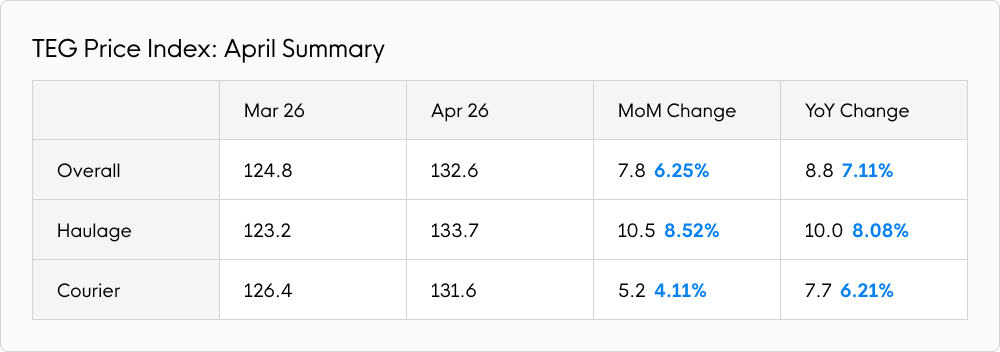
The TEG Price Index rose by 7.8 points (6.25%) in April to reach 132.6. A widely anticipated jump in transport prices, it follows ongoing volatility in the Middle East oil market.
The Haulage Index led the growth, rising by 10.5 points (8.52%) to 133.7. The change was similar for haulage year-on-year; a 10-point (8.08%) increase.
The Artic Index increased more than general haulage during April, rising by 11 points (9.60%), to reach 125.7. This exceeded the year-on-year 8.8-point (7.53%) rise seen for artic transport.
Also moving upwards, the Courier Index rose by 5.2 points (4.11%) in April to reach 131.6. This was slightly lower than courier price growth seen during the last 12 months, when the Courier Index rose by 7.7 points (6.21%).
Bank holiday months typically trigger price increases, but April was also the first real opportunity to see the impact of significantly higher fuel prices on transport rates. Back in March, operators largely postponed rate changes until after Easter. We’ve now seen that transport prices have jumped significantly post-Easter, in response to significant fuel price hikes.
Bank holidays influence availability
April was an interesting month for transport. Good Friday and Easter Monday landed early in the month, constraining capacity, and shipment front-loading in preparation for the Early May Bank Holiday further squeezed April transport slack. All in, carrier availability fell by 9.95% in April.
Demand crept up slightly during April, and the typical trend is for further increases as summer approaches. Given continued uncertainty about the economy, time will tell whether this follows in 2026.
Amid the volatility, operators are increasingly turning to spot markets to nullify uncertainty. Year-on-year, 3PLs have now sourced almost 30% more carriers through the TEG platform, despite sluggish economic growth.
Fuel watch
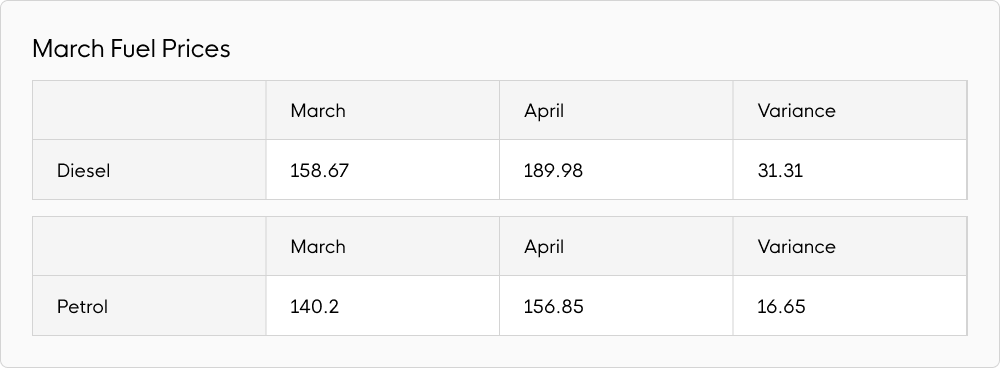
Not surprisingly, fuel prices rose at pace during April, with significant and regular jumps at forecourts.
Average diesel prices experienced the most aggressive growth, rising to 189.98p per litre in April. This was 31.31p (19.73%) higher than in March. Compared to April 2025, diesel prices are up by an eye-watering 48.29p per litre (34.08%).
The average petrol price also increased significantly last month, but less so than diesel. Petrol reached 156.85p per litre in April, rising 16.65p (11.88%). Year-on-year, average petrol prices increased by 22.3p per litre (16.57%).
Weekly average fuel prices eased a little from 20 April, but this is likely to be short-lived given the ongoing blockage of the Strait of Hormuz. Throughout the summer, at least, fuel prices are likely to remain painfully high.
Factors affecting fuel prices
Oil prices hit a four-year high last week (30 April), briefly rocketing to $125 a barrel, following reports that the US was considering further strikes on Iran. The global impact of Trump’s actions continues, not least at a crucial cost for the haulage industry.
The news that the UAE is leaving OPEC could improve oil prices in the medium term. Having invested heavily in the industry, the UAE hopes to increase production, and certainly has the capacity to do so. As the UAE accounts for 15% of OPEC’s output, its departure is a significant blow for the cartel that has controlled output and oil prices since 1960. Experts suggest that the UAE could boost oil production by around one million barrels a day when not part of OPEC.
But in the short term, at least, prices remain high, and even when hostilities in the Middle East end, it could take six months for shipping through the Strait of Hormuz to return to pre-war levels.
This challenging situation has led to calls from the industry for the government to act. Richard Smith, RHA MD, questioned why the UK government has not stepped in yet, saying it “has the tools available to act if the will exists.” Hauliers in Ireland, Portugal, and Spain are now receiving support, such as rebates and fuel tax cuts. The RHA would like to see something similar in place for UK haulage companies given the impact high fuel prices could have on the wider economy.
Industry pulse
The Bank of England voted to hold interest rates at 3.75% for a further month last month. A reprieve for now, but the rate-setters expect base rates to rise in the future. This month, they’re watching the impact of the Iran war carefully while suggesting UK households should brace themselves for what has been coined “Trumpflation”. Policymakers believe cautious consumers may prevent retailers from aggressive price hikes.
The best-case scenario for inflation, according to the Bank of England, is that it won’t peak above 3.5% in 2026. But this depends on both the length of the Iran war and on how long oil prices remain high. The Bank has suggested inflation could, in some scenarios, hit 6% before the year ends. It’s already clear that utility bills will rise from July, and food inflation is expected to reach 4.6% by the autumn.
The GfK Consumer Confidence Index dropped by four points in April. This followed a two-point drop in March. The biggest falls were seen when considering the general economic situation, which is not at all surprising. Consumers are feeling unsettled and cautious right now, which is sure to affect demand across a variety of goods and services.
The latest CBI Industrial Trends Survey suggested caution too. More manufacturers thought that output would decrease over the next three months than thought it would increase (a difference of -20%). In March, the balance was +0%, so that’s a shift into the red.
The average HGV driver salary remained relatively stable in April, reaching £41,822. Given it stood at £41,851 in March, the drop was somewhat limited.
Expert comment
“The current cost of diesel was bound to impact the various TEG indices. Diesel is higher than it was at this point following the invasion of Ukraine, although not quite high as July 2022. But oil experts say it’s likely to remain high because of the impact of the current crisis on downstream refining facilities.
We also understand that the Bank of England is concerned about stock markets falling, potentially impacting ability to raise funds, particularly for businesses in difficulty rather than those intending to invest. Select your customers carefully – there’s a lot of benefit to getting paid quickly!”
Kirsten Tisdale – Senior Logistics and Supply Chain Consultant – Aricia Ltd